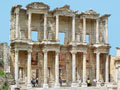
The nearby archaeological site of ancient Ephesus has its own guide with information and a photo gallery.
 |
 |

Detailed information about some of Selçuk's sights can be found with the photos in our three-part photo gallery.
 |
 My Favourite Planet decided that Selçuk deserved its own section. It is a modest little town and is often skipped by tourists, especially package tourists on excursions who rush to see the magnificent remains of Ephesus 3 km (2 miles) sothwest of here. Since the archaeological site now has its own restaurants and tourists shops, there is less reason for tourists to come into the town. After the usual programme of tour, lunch and shopping, they are whisked off in their bus to the next destination or back to their hotel.
 But Selçuk is worth visting, and not only for its archaeological museum, whose exhibits help understand the history and former grandeur of the place. It is an easy-going town, and its pedestrianized shopping street with its cafes and restaurants provide a welcome break from the more crowded seaside resorts. You may also find that prices, e.g. for accommodation and carpets, are lower here than in the more touristy areas.
 The remains of the Roman aqueduct, the early Turkish Isa Bey Mosque (Isa Bey Camii, built 1375), the Basilica of St. John the Evangelist and some of the old houses and small mosques also lend the place some of its charm. The people also have their own gentle charm, and many of them have learned some of at least two languages (mainly German and English) the better to serve visitors. They also offer an unconditional welcome to the storks who return here each spring and build their nests on every available perch.
 Each winter Selçuk hosts a bizarre camel wrestling championship, a must for all true sports fans.

 This is the oldest site of Ephesus, the ancient city which was moved twice due to the silting up of its harbour on the River Cayster (today called Küçük Menderes, "Little Maeander") before eventually being abandoned altogether. Archaeological finds point to settlement by Anatolian peoples long before the arrival of the Ionian Greeks in 1000 BC. It is thought that the earliest inhabitants lived on the acropolis or Citadel on top of the hill now known as Ayasuluk. At that time the Aegean Sea lapped at the western foot of this hill. Now the coast is over 5 km away, with flat marshy land in between.
 During Greek and Roman times Ephesus' main claim to fame was the fabulous Temple of Artemis, one of the Seven Wonders of the World. The sanctuary and temple of this mother goddess was actually rebuilt at least twice, but always remained on the same site despite the removal of the city. Since prehistory it was a primary religious centre and an important place of pilgrimage. Its remains, one reconstructed column and a few stones standing in a swamp on the edge of Selçuk, can be seen as sad or inspring, depending on your powers of imagination and mood.
 Selçuk and Ephesus also became important places of pilgrimage for Christians since the religion's beginnings. The Virgin Mary and Saint John the Evangelist, apostle of Jesus, are said to have lived here. (The "House of the Virgin Mary" is about 7 km from Selçuk.) By the time Saint Paul the Apostle arrived (around 52 AD) there was already a Christian community, making it one of the founding churches, later to be known as one of the "seven churches of the Apocalypse" due its mention in the Book of Revelations.

According to Christian tradition, Saint John the Evangelist, also known as Saint John the Theologian, wrote the Gospel of St. John here, lived to a ripe old age, and was buried on the hill below the citadel. His shrine was replaced by a church in the 4th century, then by the present basilica (with dimensions almost matching those of the Temple of Artemis) by the Byzantine emperor Justinian the Great in the 6th century, around the same time as the building of Aghia Sofia in Constantinople (Istanbul).
 There is a controversy about the identification of Saint John (or possibly many Saint Johns) as author of parts of the New Testament, which we discuss in the photo gallery pages about Saint John's Basilica.
 During the Byzantine era, the name Ephesus was largely forgotten and the place took on the name Agios Theologos (in Greek Άγιος Θεολόγος), from which the Turkish name Ayasluğ (or Ayasluk) is derived. In 1914 the town was renamed Selçuk, in commemoration of the Seljuk Turks who settled in the region in the 12th century.

Text and photos: © David John 2004 - 2010
 Some of the information and photographs in this Selçuk guide of My Favourite Planet first appeared in 2004 on www.davidjohnberlin.com. |
| Selçuk, Turkey |
 |
 |
area map |


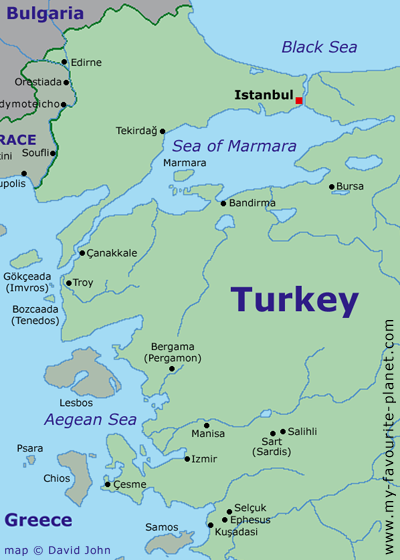
 map of Aegean area and western Turkey
 |
| Selçuk, Turkey |
 |
 |
practical information |
Selçuk is the main town of the Selçuk district, in Turkey's İzmir Province. It is 18 km (11 miles) northeast of Kuşadası, and 3 km (2 miles) northeast of the Ephesus archaeological site.
 |
| name: |
Selçuk, Selcuk
 |
| region: |
Aegean, Mediterranean
 |
| province: |
Izmir
 |
| district: |
Selçuk
 |
| population: |
23,000
 |
| local time: |
Eastern European Time (EET) Daylight Saving Schedule:
Summer (from last Sunday in March) GMT/UTC +3 hours
Winter (from last Sunday in October) GMT/UTC +2 hours
 |
| dialling code: |
+90 232
 |
| currency: |
Turkish Lira (TRY)
 |
| climate: |
Mediterranean
 |
| language: |
Turkish
 |
Local telephone numbers

Selçuk Tourist Information Office: (02 32) 892 63 28
Atatürk Mah., Agora Caddesi 35. www.selcuk.gov.tr

Selçuk Municipality Office: (02 32) 892 69 25 / 892 69 11

Police Headquarters: (02 32) 892 60 04

Hospital: (02 32) 892 70 36

Further information for Turkey, including visa details, can be found on the main page introduction to Turkey.
 |
Selçuk Ephesus Archaeology Museum

Further details in the Selçuk photo gallery Part 2
 |
| Tel: |
(02 32) 892 60 10
 |
| Opening hours: |
Summer – 08.30–12.00 & 13.00-19.00

Winter – 08.30-12.00 & 13.00-17.00
 |
Other places of interest in and around Selçuk
 |
| • |
Saadet Hatun Public Bath Museum, a restored 16th century Turkish hamam.
 |
| • |
Çamlık Open-Air Rail Museum in the village of Camlik, around 10 km from Selçuk.
 |
| • |
Sütni Cave outside Selçuk, with stalagmites and stalactites which drip white water into the cave. According to local superstition, mothers who do not have enough milk for their babies drink the water from the cave.
 |
| • |
Selçuk Gevekirse lake, to the north between Ephesus and Pamcak, is a bird reserve with around 40 species of birds and animals, including pelicans, ducks, woodcocks, wild boar, foxes and jackals.
 |
| • |
Şirince, a traditional village 7 km southeast of Selçuk, with narrow streets, old houses, fruit orchards, home-made wine and lace made by the local women. It has a few pensions and restaurants. Formerly Kirkince, founded by Greeks around 800 years ago. Since the population exchange between Greece and Turkey in 1924 it has been inhabited by Muslims from Thessalonica.
 |
 Some of the information and photos in this guide to Turkey originally appeared in 2004-2005 on davidjohnberlin.com. |


 |

NEW


 Guide to Planet Earth |