|
|
 |
| My Favourite Planet > English > Europe > United Kingdom > England > Avebury |
|
| Avebury |
Introduction to Avebury |
|
page 1 |
 |
|
|
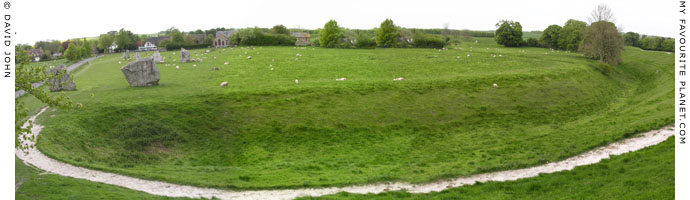
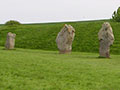
Avebury Henge, the southeast quadrant of the Circles and surrounding ditch. |
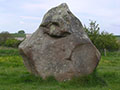
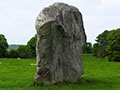
The tiny English village of Avebury stands on the Marlborough Downs, in east Wiltshire, about halfway between the market towns Marlborough and Calne. It is at the centre of an area covered by Neolithic and Bronze Age settlements, tombs and arrangements of huge stones (megaliths), the best known of which is the 4,600 year old Avebury Henge, the largest prehistoric stone circle in Europe.
The nearby stone circle Stonehenge is internationally much more famous, partly due to its strong, distinct architectural form which makes it as instantly recognizable as the Acropolis or the Eiffel Tower. Thus Stonehenge has become a trademark landmark for British culture and tourism.
The arrangement of Avebury Henge and the surrounding complex of ancient monuments is harder to grasp from a single viewpoint or photograph. However, the free public access to the enigmatic sites, set in a beautiful, tranquil landscape of green, rolling hills, is attracting ever more visitors and admirers.
This was not always so. Avebury's pagan stones were forgotten by the world for many centuries, and reviled as the work of the devil by the Christian Church and superstitious locals who made successive attempts to destroy them. See a brief history of Avebury on the next page for further details. |
| Geography |
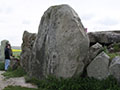
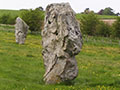
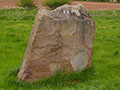
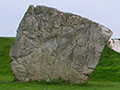
The Marlborough Downs is part of the extensive North Wessex Downs, designated an Area Outstanding Natural Beauty in 1972, which covers 1,730 square km (668 square miles) across the southern English counties of Berkshire, Hampshire, Oxfordshire and Wiltshire. Two of the physical characteristics of the Downs are the rolling chalk landscape and the deposits of sarsen stones, the hard sandstone blocks shorn off from the tertiary rock bed which once covered much of southern England. Neolithic people used these stones, some weighing more than 60 tons, to build their tombs and stone circles.
Further information about the North Wessex Downs:
www.northwessexdowns.org.uk
Information about Areas Outstanding Natural Beauty (AONBs) in the United Kingdom: www.aonb.org.uk
As with much of northern Europe, the area was once heavily wooded before man cleared trees for building, fuel and farming. There were 7 acres of woodland in West Kennett in 1086, but by the late 18th century it had become sparsely wooded. Today most of the land used for sheep grazing and cereal production.
Although the Downs retains its rural atmosphere it is dotted with towns and villages, many of which have their own charm as well as historical and architectural points of interest.
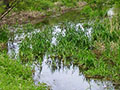
The River Kennet has been assigned as a Site of Special Scientific Interest (SSSI) because of the rare plants and animals which live in and around it.
The Kennet is fed by several springs and streams, particularly the Sambourne and Winterbourne streams which flow south from near the villages of Uffcott and Broad Hinton and merge to the west of Avebury village. The Kennet continues to run south for 1.5 km to Swallowhead Spring where it turns westward on its way to join the River Thames at Reading in Berkshire. |
See also:
Page 4: How to get to Avebury by train, bus, car (including parking) or on two wheels. Also walking around Avebury.
page 5: Practical information about Avebury:
the Tourist Information Centre, disabled access,
eating, drinking, shopping and accommodation. |
|
| |
| |
|
Articles and photos: © David John, except where otherwise specified.
Many thanks to Mark Mallett, my host and guide in Wiltshire.
Some of the information and photos in this guide to Avebury
first appeared in 2005 on www.davidjohnberlin.de.
All photos and articles are copyright protected.
Images and materials by other authors have been attributed where applicable.
Please do not use these photos or articles without permission.
If you are interested in using any of the photos for your website,
project or publication, please get in contact.
Higher resolution versions are available on request.
My Favourite Planet makes great efforts to provide comprehensive and accurate information
across this website. However, we can take no responsibility for inaccuracies or changes made
by providers of services mentioned on these pages.
We welcome considerate responses to these articles and all other content on My Favourite Planet.
Please get in contact. |
|
 |
Visit the My Favourite Planet Group on Facebook.
Join the group, write a message or comment,
post photos and videos, start a discussion... |
|
|
| |
|
|
| |
| |
 |
| |
 |
| |
 |
| |
 |
| |
 |
| |
 |
| |
George Alvanos
rooms in
Kavala's historic Panagia District
Anthemiou 35,
Kavala, Greece
kavalarooms.gr
|
| |
Papoutsis
Travel Agency
Kastellorizo,
Greece
+30 22460 49 286
papoutsistravel.gr
|
| |
|