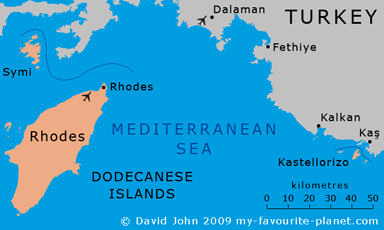
It's difficult not to like Kastellorizo. Whether you have just arrived from the intense tourist pressure-cookers of Rhodes or one of the nearby Turkish resorts - and these are the only places from which you can get here, unless you have your own boat or private spaceship - you step into a more relaxed island village atmosphere. It has no golden beaches, spectacular ruins nor the folklore charms of many Mediterranean "corners" (places away from the hectic urban centres and tourist traps), but it definitely has a character it can call its own.
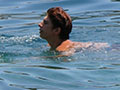
For those who are interested in the island's long and varied history, geography or geology (caves and all), it is a place where you can roam and explore without hindrance or fences. A rare and wonderful freedom. You have to be fit, and due to the topography the island, places beyond the main village are pretty inaccessable to disabled people. If, on the other hand, you just want to enjoy the friendly, informal atmosphere under the sun and stars, relax amongst Greek people who really know what the word relax means, eat and drink well and perhaps swim in crystal-clear water, then go ahead - who's stopping you?
This is not a place of wild excess or all-night techno rage, though nobody stands in the way of partying; it's just that you would be hard-pressed to find either a quorum or critical mass to get such a thing going. That all belongs in another world. It doesn't mean that the islanders don't know how to enjoy themselves, and if you want to, there are a couple of places to eat, drink, make merry and discuss the meaning of life, love and fried sheep's cheese well into the wee hours.
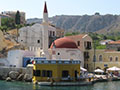
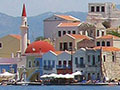
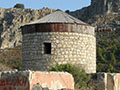
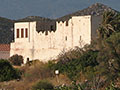
A young Greek couple from Rhodes visiting the island for the first time, said they thought Kastellorizo was a rustic place at the end of the world. Perhaps they were right, although maybe they had not yet explored some of the further edges of their own island. A Dutch couple in sturdy shoes determinedly hiked around the island's tough terrain to explore ill-defined ancient ruins, deserted farms and vineyards, numerous Greek Orthodox chapels and nonchelant goats, despite the 43 degree Celcius heat, and found it exhilerating. An English family preferred to moor their small yacht and enjoy less arduous walks around the attractions of castles, mosque and museum near the main harbour before dressing for dinner at a harbour-side taverna. Each to his/her own taste.
A word about the friendliness of Kastellorizians. They are mainly friendly, polite and helpful, but not overly so. As mentioned above, when arriving from the tourists hotspots of Rhodes or Turkey, when you arrive in/on/at Kastellorizo you are entering a different world. People don't fall over you or try to seduce or blackmail you into their shops and restaurants. Nobody's doing that here. It's a small place, everybody's got to eat somewhere, and each finds their own favourite, food, waiter/waitress, view, location or price limit. Not only don't they angle customers with false smiles, the Kastellorizians can sometimes seem rather cool or distant (perhaps it's just tourist fatigue). Actually this is quite a relief from the pressure of other holiday locations. Be reassured, if you make the small effort to be friendly, your labours will be appreciated and returned.
We enjoyed and recommend Kastellorizo, and left wishing we could have spent more time there. A good feeling and purely subjective. Why not? As soon as I can get more objective about the place I will rewrite this page. Meanwhile, if you have anything to add, please feel free to get in
contact.