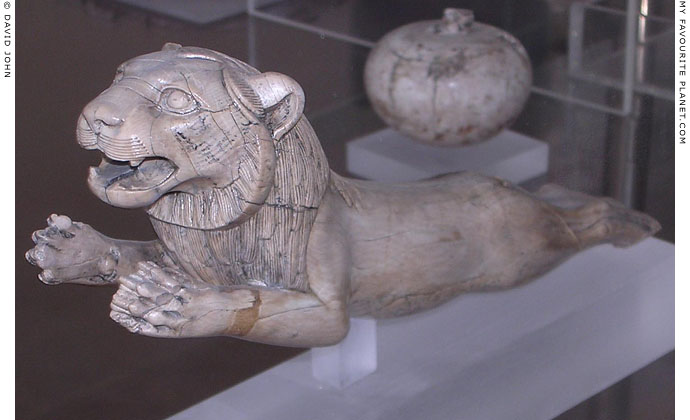
A finely carved and lifelike work, thought to have originally decorated a vase or a piece of furniture. It was discovered with several other ancient works in wells at the Sanctury of Hera (Heraion), near Pythagorio.
Archaeologists believe it came from the tomb of an Egyptian pharaoh of the 18th or 19th dynasty (13th - 12th century BC), and may have been brought to Samos by Phoenician travellers and dedicated as a votive offering at the Heraion in the second half of the 7th century BC.
Helmut Kyrieleis of the German Archaeological Institute (Deutsches Archäologisches Institut), who directed the excavations at the Heraion from 1976 to 1984, suggested that it may have been purchased from grave-robbers by a Greek in Egypt who considered it as an antique, and points out that Egyptian legal documents record systematic plundering of pharoahs' tombs as early as the 2nd millenium BC. [1]
Egyptian ivory lion, Ramessid period. Inv. No. E 133.
See a photo of quite a different lion in Vathy, Samos on gallery page 2.
Samos Archaeological Museum
(Αρχαιολογικό Μουσείο Βαθέως Σάμου)
In the centre of Lower Vathy.
Opening times
Summer (1 April - 31 October):
Tuesday-Sunday 09:00-16:00.
Monday closed.
Winter (1 November - 30 April):
Tuesday-Sunday 08:00-15:00.
Monday closed.
Admission 3 Euro; reduced tickets 2 Euro.
Tel: +30 2273 027 469
Website: www.odysseus.culture.gr |