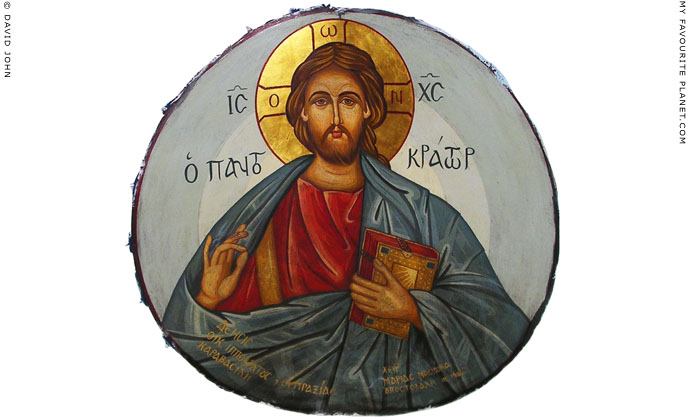
The icon of Christ the Pantocrator is in the chapel above the cave of the Panagia Spiliani Monastery (see previous page), high on the wall as it curves to the ceiling, which accounts for its distorted shape in the photo. The painting is signed "Marias Nasioka Apostolaki 18. 1980".
Icons of Christ as the Pantocrator (Ο Χριστός Παντοκράτωρ, Christ ruller of all) are found in churches all over the Orthodox world. The oldest known example in Saint Catherine's Monastery, Sinai, Egypt, is dated to the first half of the 6th century. Another famous depiction of Christ in this style is part of the Deesis mosaic (δεησις, prayer, supplication, beseeching) in the Hagia Sofia, Istanbul, thought to have been made in the 12th or 13th century.
In traditional Pantocrator icons, Jesus is usually shown with long hair, parted in the middle and swept back, a long moustache and a beard. His expression is usually grave. He wears a cloak over a tunic. In his left hand he holds a Bible, and with his left hand he makes the sign of the blessing. |
|
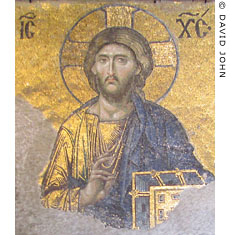
Mosaic of Christ Pantocrator
in the Hagia Sofia, Istanbul. |