Yes, we consider eating and drinking to be activities. Not as strenuous as rock climbing or paragliding, perhaps, but all that finding the right restaurant, table and waiter, deciphering the menu, not to mention chewing, conversation and people-watching... It all keeps you busy for at least an hour or two.
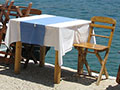
For such a small village Kastellorizo actually has a lot of places to eat and drink, all catering for the tourist trade. Most of the restaurants and bars are around the harbour front where it can get get quite crowded on summer evenings.
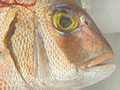
As you would expect, all the usual Greek dishes are on offer, including a wide variety of locally caught fish plus a few local specialities.
Some visitors complain that Kastellorizo is quite expensive, while the Kastellorizians argue that just about everything has to be imported to the remote island. This is the case in many of Greece's small islands. Generally, Greece has become a much more expensive place to visit since the introduction of the Euro, and eating and drinking out can be as dear or even dearer than in northern Europe. It is ironic that it is generally cheaper to eat in a Greek taverna in Berlin than in a comparable eatery in Greece itself. But as the Greeks say, "etsi einai zoe" (that's life).
We noticed that none of the grocery stores on the island ever seemed to be open. Do you have to make an appointment to buy potatoes here? Or is this a sneaky way to force tourists into the reastaurants and bars?
Although we were staying in an apartment with a kitchen, we had nothing to put in the fridge (apart from bottles of water) and nothing to cook on the cooker. Not that we wanted to anyway, but . . .
Luckily the local municipal bakery (demotikos fournos) was open and offers a variety of fresh, tasty wares. We found their excellent spanakopitas (spinach pies) to be lifesavers as we explored the island. Otherwise sweets and drinks can be bought at the gift shops on the harbour quay.
Those who spend a couple of days or more on the island will quickly find their own favourite place to eat and drink - a place that suits their palate and wallet. No doubt the location, the view, the atmosphere and the personality of the waiter / waitress / owner may also play a part in where you choose to park your hungry frame.
If you want to get away from the harbour front there are a few places you could try:
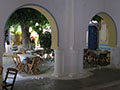
We can recommend The Olive Garden (Elaionas), around 50 metres away from the quay in the centre of the town. Run by a couple, Monica (from Germany) and Damien (Australian Greek), the Garden has a relaxed, friendly atmosphere, good food and reasonable prices. Excellent breakfasts from 11 am. The multilingual pair also have an excellent sense of humour, for which they get extra bonus points. www.kastellorizo.de
Photos and further information on gallery pages 119 - 121.
Meanwhile, over in the Horafia district evenings are relatively quiet. The Mediterraneo Taverna, on the square near the Agios Georgos Tou Horafiou church (Saint George of the Fields), is a down to earth kind of place which serves good basic Greek fare.
The taverna is named after Gabriele Salvatores' 1991 Oscar-winning Italian war film Mediterraneo which was filmed on Kastellorizo. The film's popularity draws a lot of tourists here, particularly Italians. The inside of the taverna is plastered with autographed posters and other memorabilia from the movie, and the term "cashing in" springs to mind. Quite harmless really - as long as everybody is having a good time.
They didn't have a menu, but the owner recited what was available that evening. As is customary in Greek tavernas, you are invited to go into the kitchen see what's on offer. The wine comes in the usual red aliminium litre or half litre carafes (the Greeks say kilo and half kilo - miso kilo, as if they weigh the wine), and the beer is either Mythos or Amstel *. The food, service and prices were acceptable, and the quiet atmosphere of the square, surrounded by illuminated churches, is a relaxing change from the busy seafront.
* Curiously, on the island Mythos beer is served in 0.5 litre bottles, while Amstel was only available at the smaller 0.3 litre size, which works out more expensive. Both beers are produced in Greece. A waiter told us that these are the only volumes that the suppliers deliver and that local outlets have no choice in the matter. Very strange business, don't you think?